Office Furniture and Fitout. How office shape can reduce usable space.
17th June 2014
By Crispin Maby
When trying to figure out what office furniture you can fit into your new office, or what layout of meeting rooms, cellular offices and desks you might achieve, then the shape of the space often becomes a very important factor. If you have 10 staff and an office the size of Heathrow Airport, then it probably doesn’t matter in the slightest, but if like most London based businesses you’re paying £80 (including rates and service charges) or more per square foot and you need maximise every available inch of your office, then shape most certainly does matter. Much depends on how you want to use the space and it’s fair to say that what might be ideal for one business can be completely inappropriate for another, but the important message here is that the shape, rather than the size can often be the determining factor.
I’ve said it before in other articles, but you must never assume that two offices of the same floor area will give you the same results. Quite often you can fit considerably less of whatever it is you want to fit into one office than you can into another office of exactly the same floor area. So let’s look at a few examples, but before we do, I’ve introduced a few rules. Firstly, there’s the 11 cubic metre rule (an HSE requirement) and all of the CAD plans I’ve drawn and shown below give each desk/user at least 11 cubic metres assuming the ceiling height is 2.8m or more. Secondly, we must allow a main traffic aisle through the office of at least 1.2m wide (in larger offices this may need to be increased in width or perhaps duplicated or triplicated – i.e. two or more main aisles of 1.2m wide dependent on the size of the office and layout of desks). Thirdly, although not a legal requirement (as far as I know), I always like to allow at least 2m spacing between desks that are back-to-back in order that users don’t clash chairs and that there’s sufficient room for people to walk behind, and where a desk is backing onto a wall I like to allow at least 1m between a desk and the wall behind it, and 1.5m if there is a run of more than 1 desk side-by side (this is a personal view and legally you might get away with less but it depends on many other factors that I’m not really qualified to comment on). Finally, I’ve used regular sized 160cm by 80cm rectangular desks in all of my plans and of course you might argue that if we use smaller desks we can get more people in, but I’m trying to demonstrate a point here and comparing like-for-like, so 160m desks it is for the purpose of this exercise!

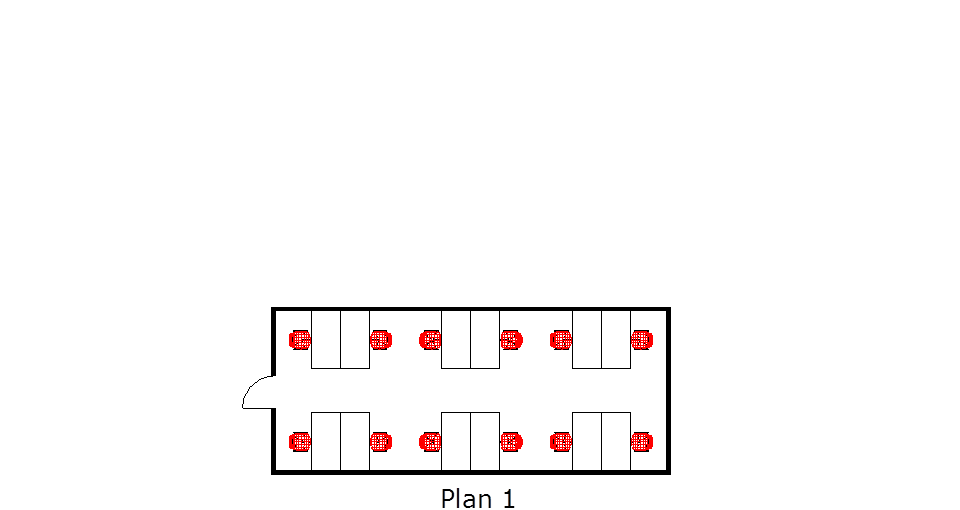
Plan 1 shows a room which can comfortably fit 12 desks. This room is exactly 47.52m². Plan 2 is also exactly the same size at 47.52m² but as you will see, it’s a different shape and due to this there simply isn’t sufficient space to fit any more than 10 desks.

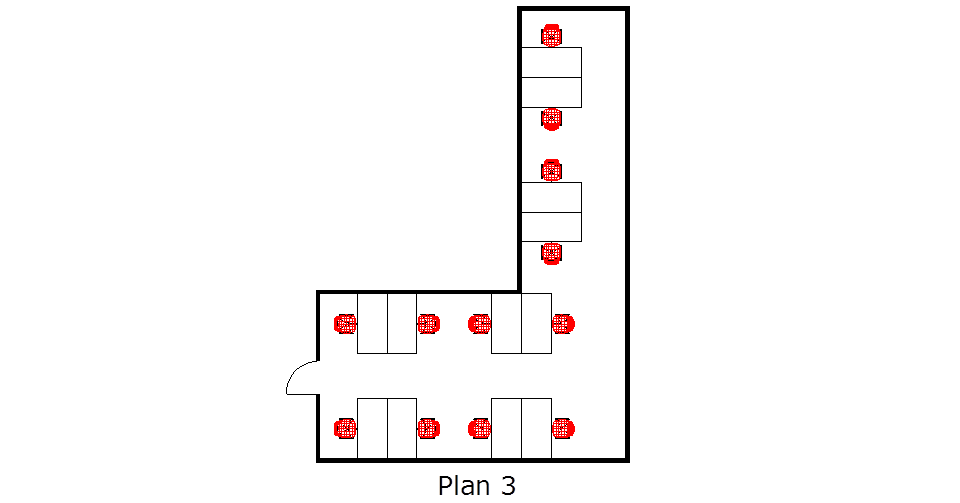
Looking at this in a slightly different way, lets now examine how large two different-shaped offices (differently shaped to plan 1 that is) need to be in order to fit the same quantity of desks as plan 1. Plan 3 is an extension of plan 2 and is 57.32m², and plan 4 shows a long narrow office of 77m², but both only sufficiently large to fit twelve 160cm desks. So on one hand we have a 47.52m² office in plan 1 which is sufficiently large to fit 12 of our desks, and on the other hand we have another office of 77m² (plan 4) which is also only big enough for the same 12 desks. This one is a whopping 62% increase on the first office in figure 1!
By now you will be saying “we understand your point, but in all of these other plans there’s extra space which, although not quite sufficient to fit desks, is certainly good enough to be filled with all the other furniture we’d expect to have in our offices such as cupboards, soft seating, casual meeting areas and the like”. Yes, you’re absolutely right, but I’m trying to demonstrate a point without being absolutely specific to a particular office or space requirement, and besides, I will argue that these might well be rooms into which you need to cram as many desks as (legally) possible as you have all your storage, reception areas, meeting rooms and so on elsewhere in the building. Other factors also come into play, not just size and shape, such as the presence and position of structural pillars or columns which I have also written an article on, low or tapering ceilings, position of windows and much more besides.
What’s the financial impact? London commercial property specialist Warwick Bookman informs me that as a rough guide a company signing a lease today for offices in central London is typically paying an average of £50 per square foot rental, plus £20 per square foot on rates, and £10 per square foot on service charge – totalling £80psf! And this is just an average figure – prime space in the west-end is going at £100 psf on rental alone. So, let’s assume that plan 1 would be absolutely ideal for your requirements if you could get it, but you can’t and so you have to settle for plan 4 instead. At £80 per square foot (or £861 per sq metre), the office shown in plan 1 would cost you £204,573 over a typical 5 year lease term. This equates to £17,000 per desk. The office shown in plan 4 would cost you £331,485 over a 5 year lease which equates to £27,600 per desk. That’s a considerable extra cost and hopefully this demonstrates how important it is to ty to find the ideal office to suit your requirements specifically, rather than having to opt for something bigger with a lot of unusable space that you’re paying a high price for.
To conclude, the main message I want to put across here is that advance planning (even basic space planning) is so important. Renting office space is a huge financial commitment and the mistake I see made most often is that under the immense pressures of trying to get the lease signed companies don’t always check in advance that the office they’re about to take on is the right size and shape for them. Only when they’re fully committed do they then discover that they will have to make compromises, sometimes massive ones, on the size and layout of desks, partitioned offices, meeting rooms and so on. Occasionally and most critically, it means not being able to fit enough people into the office.
________________________________________________________________________________
Office fit-out & furniture. How pillars can reduce usable desk space
11th June 2014
By Crispin Maby
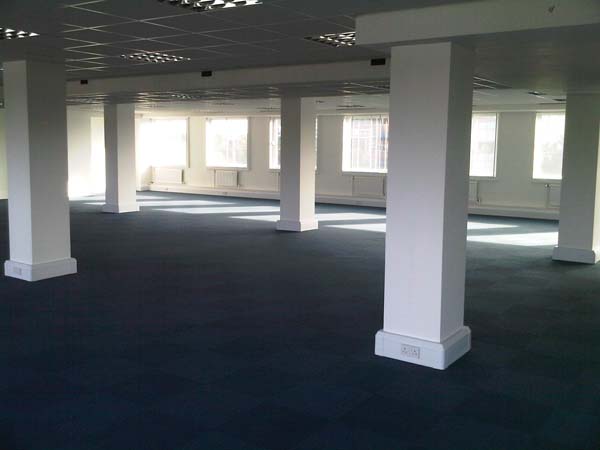 You might have found a nice big rectangular open-plan office to move to which all looks perfect and the square footage is exactly what your agent suggested would be right for your staff numbers and general requirements. But hold on, I want to show you how two offices with identical dimensions can have completely different usable space attributes. This article examines the effect of structural columns (pillars) that are more often than not found in office buildings, sometimes to a greater and other times a lesser extent.
In an ideal world, you want to try to find an office space with minimal or no columns. Easier said than done, but as we will see in a moment, the impact pillars have on the overall area (square feet or sq m) is usually absolutely minimal, however the impact they have on how you can use the space can be dramatic.
Below we have two floor plans of exactly the same open-plan office, the same, that is, except that I have added some columns to the second drawing. The columns, each having a foot print of 0.16 square metres, take up less than a one square metre in total. The total floor area is 256m², but with the addition of the columns, figure 2 is reduced by just 0.8m² to 255.2m². Hardly worth worrying about is it. Or is it?

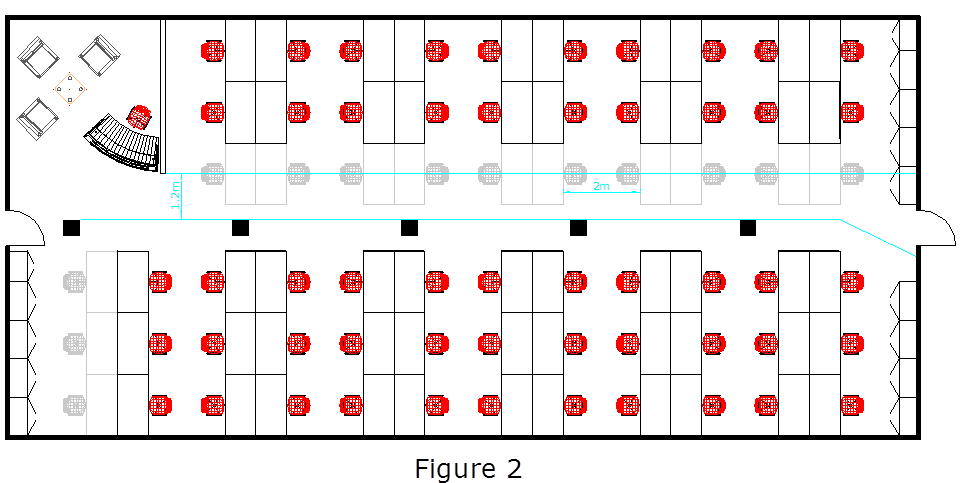
We always have to be mindful of the fact that sufficient space must be left between desks to allow people easy access, and also that the main circulation channels (aisles, traffic routes or corridors) need to be sufficiently wide and un-obstructed, so I have allowed 2m spacing between desks back-to-back, and a 1.2m width main aisle running through the office (this is show as 2 thin blue lines). Another consideration is an HSE requirement that each person has at least 11 cubic metres of space, and this is dealt with in a separate article about how much office space I need.
As you can see, of the 66 desks we had in figure 1, thirteen need to be removed from the second plan (desks shaded in light grey) bringing the total down to 53 which is a reduction of almost 20%. The reason for this is that due to the positioning of the columns, the layout no longer provides for a sufficient main aisle and we therefore had to move this into the space that desks were previously occupying. The three desks near the entrance also need to come out because there would now not be sufficient access space for the people sitting at those desks.
So you can see that a small change can make a big difference and this is why you should never assume that two offices of similar floor space will give you the same amount of usable space. Of course, in some circumstances you might be able to use smaller desks or use the redundant space for something else, but that might be a compromise you don’t want to make.
I hope you have found this article useful.
_______________________________________________________________________________
2nd Hand Office Furniture – Paying someone to take it away?
6th June 2014
By Crispin Maby
It often comes as quite a shock when a business owner discovers that the office furniture they paid many thousands of pounds for only two or three years ago, and which is still in excellent condition, is apparently now not worth a penny. Worse still, the second-hand office furniture dealer wants to charge them hundreds or even thousands of quid for taking it away! Having charged to take it away, the same furniture pops up on the dealer’s website the very next day with an asking price of up to half the price that the product was purchased for when new. A very tidy profit you might say!….. or is it?
Are we being ripped off or is there justification in this? Is it fair that the dealer charged for taking it away (and seemingly getting it for free) and then selling it on at thousands of percent profit?
On the whole, there is money to be made out of second-hand office furniture otherwise the companies that specialise in this area wouldn’t justify their existence, but it’s also fair to say it’s not always as profitable as it first appears, so let’s look at why.
First and foremost the process of acquiring and selling used office furniture costs money, and often a considerable amount of money. To explain this, I thought I would summarise the experience that my company had when we first ventured into the second hand furniture market, and most of these issues are fairly typical of those encountered by organisations and individuals that offer office clearances and/or specialise in the field of second user office furniture.
Until this time we had supplied only new products, but when we were approached by a private equity company in central London that was closing its UK operation and wanted to clear its office of all furniture, we agreed to purchase it for a modest sum. Now you would assume that we, having been in the office furniture business for many years, knew exactly what we were getting into, but in truth we didn’t. As would become apparent later on, we had completely underestimated the time and costs involved and although we ultimately turned a profit, with the benefit of hindsight we would not have done this deal if we had known then what we know now.
We agreed to pay £2,000 + VAT for the furniture. The deal was that we had to collect it at our own expense and we had to take everything, including the items we didn’t want. Most of it was good quality from known leading brands, but it was 5 years old and some of it had a few dinks, marks and scratches but nothing major. Initially it looked really good. There were 15 high-end task chairs, 42 expensive looking (that apparently were very expensive to buy new) conference chairs, 30 other meeting chairs, 25 desks, 2 boardroom tables, 40 heavy duty lateral side-filer filing cabinets, 5 cupboards and much more besides. We estimated that the customer had probably paid in excess of £80,000 for all this furniture when new, and we were getting it for just £2,000 so we were bound to make money.
The first problem was the effort getting it out of the building. We were given just 2 days (specific dates which we had no say in) to get everything removed and we were given no time to plan ahead. The customer was very relaxed, but their landlord was completely unforgiving and insisted that we had to do it during normal working hours but they only gave us restricted use of the lift, which we had to use because the office was on the 6th floor. Parking outside was non-existent and having got items down to the basement there was nowhere to hold them so they had to go straight out onto a van. And whenever we were loading a van we had to have an extra man guarding the tradesman’s entrance we were using. Had we have been scrapping all this furniture rather than keeping it for re-sale, the process would have taken considerably less time and with far fewer men (even allowing for the landlord’s restrictions) because we would not have had to take care with the dismantling, handling and loading of the furniture in the vans, and everything would have simply been chucked into a waste cart-away truck waiting outside. As it was, we had 5 vans making multiple trips to the warehouse and 7 men working 2 extremely long days before we managed to get everything back and stacked neatly in our warehouse. Once back at the warehouse, we then had to inspect, clean and catalogue everything.
In the process of working under very difficult conditions, as best we tried to protect everything as much as we could, we still managed to scratch and devalue further a few items in transit.
Then came our attempt to sell everything. The 15 task chairs went immediately and at £130 each we probably sold them a bit too cheaply (they would have cost around £500 new) – our fault! The designer boardroom chairs, although very nice and very expensive when new (we know the customer had paid around £750 each for these), were from one of the less well known top brands which only an office furniture anorak would probably have heard of, so although their pedigree was not in question but they were not familiar to the people we wanted to sell them to and in desperation after holding them for 4 months we finally found a buyer who was prepared to pay £85 each for the whole lot. So we had now taken £5,500 having paid £2,000 for it but incurring estimated costs of £3,000 or more in labour and transport during the acquisition phase, plus the deliveries of what we had sold to the 2 customers.
So at this point we had broken even, and we still had a whole load more to sell but the problem was that most of what we had left was even harder to shift. The desks were really good, but they were the wrong size, shape and colour for most peoples offices. The filing cabinets were immensely heavy – so much so that they were difficult and uneconomical to transport for the small amount anyone was prepared to pay for them. The lime green colour of the large and stunning reception counter complete with illuminated panels was only any good to anyone if it fitted their space and colour scheme, and the other meeting chairs, although an expensive quality brand, looked a little ordinary. And there was a lot more besides which we won’t go into, but needless to say that over time we managed to sell a large proportion of this, but at very low prices and with a huge amount of effort. Coupled with this, it’s worth pointing out that much of what we did sell was to existing or new customers who had approached us for new furniture, all of whom would have bought new furniture from us had we not have offered them a fantastic deal on the second hand stuff we had simply because we were desperate to get it out of our warehouse. What I’m saying is that if we didn’t have the second hand furniture, we would still have done business and probably made better profits for far, far less effort.
As mentioned, we did eventually manage to sell off most of this, but the last 3rd was the greatest effort as it was sold as single items or very small batches. Our warehouse is unmanned much of the time, so we had to arrange to meet buyers there on numerous occasions, simply for them to inspect and/or take away a couple of desks, or a single filing cabinet. Often they didn’t turn up, and often they would be late and all in all it was generally uneconomical for us. Finally, a year on from acquiring this furniture, we had to load up 3 vans to the brim and cart all the unsellable items of to the local recycling centre.
In the end we turned a profit but not without an immense amount of time and effort, many times more than we would have had to go to in order to sell the equivalent amount of new products. So, to answer the question I asked in the second paragraph of this article, yes, in many cases I think it is fair that you would have to pay someone to collect your unwanted office furniture, even if they might then re-sell it. To summarise, here are the key points:
- It’s worth less than you think: A second-hand piece of furniture is only worth what someone else is prepared to pay for it, and the price you paid for it when it was new is normally quite irrelevant. With one or two exceptions, it’s likely that someone is probably not going to pay more for a second hand ‘quality’ desk than they would pay for a brand-new economy desk. So if the quality desk was £800 new, and the economy desk was £100 new, then expect to get no more than £100 for the quality desk when sold 2nd hand.
- Disposal: The dealer often has to take everything you don’t want anymore, including what he doesn’t want either, and he therefore has to take into account the cost of disposing of the unwanted items. Although he might be paid a very small sum for scrap value on the metal components, he still has to pay for the manpower to remove it from your building, take it to the recycling centre, van and fuel costs, and he will still have to pay the commercial waste centre a fee for scrapping all other elements (chipboard etc). All in all, this can be expensive.
- Additional processes & costs: Compared with supplying new furniture, there are a number of additional processes, each incurring costs, mainly manpower and transportation. If we were selling new desks, we’d place an order with the factory and they’d ship it out all nicely wrapped and protected either to our warehouse or, quite often, directly to our customers’ office. All we then have to do is arrange for our fitters to meet the lorry outside and carry the furniture into the building and put it together. Compare this with 2nd hand furniture. Additional process 1: Dismantle it at first user’s office. Additional process 2: Carefully load it into van and transport back to warehouse. Additional process 3: Unload at warehouse, clean it, stack it and catalogue it. Additional process 4: Re-load it onto van and transport it to new user’s office.
- Matching Sets: When buying second-hand furniture, the purchaser is most likely to need a reasonable quantity of matching desks, chairs, pedestals and cupboards to furnish their office. The dealer therefore needs to stock good quantities of matching units, and indeed selling in quantities rather than in ones and twos is the only way the dealer is going to turn a profit. Selling single items is generally uneconomical, particularly if they have to be driven into central London and installed in an office, and as often as not the buyer might as well buy a new desk or chair because the overall cost isn’t going to be that much different. Given this, if you have second hand furniture you want to sell, then you need to have matching sets in reasonable quantities if you’re going to have any chance of a dealer buying them from you. The exception to this is if you have highly desirable designer items such as Herman Millar Aeron or genuine Vitra Eames chairs which do have a good second hand value even in small quantities.
- Quality: Regardless of how many you have and how good the condition is, if you bought budget desks or chairs for less than £100 each when they were new, you should not expect a dealer to pay you anything for them 2nd hand. On the contrary, you should expect to pay them to take them away and if they do it for free you should probably consider it lucky. The reason is quite simply this. By time the dealer has gone through all the additional processes I’ve identified in item 3 above, it is quite simply completely uneconomical for him to take these low value items as he wouldn’t be able to sell them for a sufficient amount to even cover his costs.
- Warehousing: Secondhand furniture has to be stored. The cost of renting, owning or running a warehouse can be considerable and this must be factored in.
- Speculative buying: Even when taking what appear to be decent products, the dealer can never be absolutely sure he is going to find a buyer for them so he has to factor in the possibility that he might have to scrap it all. Even if he does sell some or most of it, he might then be left with odd numbers or quantities of desks and chairs that are too small to make up a sellable bundle, and he might end up having to scrap this element.
- I want to see before I buy: Just like when you buy new furniture, you probably want to go to a showroom and take a look. The facility and the staffing are all overheads that are built into the final selling price of the product. Likewise, if you buy second hand furniture, you are most likely to want to go to a showroom or a warehouse and the sellers time, and any facilities they might have to enable this process to occur, are costed overheads which find their way into the price you ultimately pay for the goods.
Hopefully this article has given you a good insight into the complexities but if you have office furniture to sell and you’re still not happy with what you’re being offered for it, you might want to explore the end-user to end-user approach by visiting our page on 2nd hand office furniture.
______________________________________________________________________________