Are Filing Cabinets & Office Cupboards finally things of the past?
19th September 2023
 Back in the mid 1980s I worked as a sales representative for a company that manufactured motorised rotating carousel shelving machines for storing files and documentation. They saved on floor space by maximising the vertical space high up above normal reach height. The higher the ceiling, the greater the potential for space saving. These same machines are still used extensively today in manufacturing and distribution for storing small parts in factories or depots but I suspect are seldom used any more in offices for documentation. Back when I was selling them they cost upwards of £6,000 which was a lot of money considering it was the 80’s, but businesses around the country still relied heavily on quickly accessible paper documentation for day to day work, and finding a way of storing it locally whilst having it easily accessible was a real challenge. In Central London where I worked, the big Banks, Accountancy Firms, Insurance Companies and Law Firms in particular were all extensive users of these things, not least I remember that even then the cost of the most expensive office space was approaching £40 per sq foot! Hospitals and medical clinics were also big users.
The job of us sales representatives included calculating how many machines would be required to store all of the customer’s existing filing, how much space they would take up and whether they would fit. One of my colleagues, Mike, sold a machine to a doctors surgery based on a space saving justification but he completely miscalculated the filing capacity. This didn’t come to light until after the customer had cleared their filing room, disposed of all their existing filing cabinets and the new machine had been installed. It turned out that not only was a second machine was needed, but also a small extension had to be built onto the side of the surgery to accommodate it! I’m not entirely sure of the outcome because it was a great embarrassment and our bosses kept fairly quiet about it, but my understanding was that under the threat of legal action and bad publicity the company had to supply a second machine free-of-charge and pay for (or at least contribute towards considerably) the building of the extension. We all found this hilarious – but not our bosses. Mike left the company shortly afterwards but still made attempts to claim his commission on the sale – unsuccessfully of course!
This was back in 1985 when we still had a typing pool and we would have to wait our turn for up to 2 weeks to have our quotations and contracts typed up on the Wang word processor, and then printed off on a printer that was about the size of Heathrow Airport and encased within a sound-proofed cabinet because it was so noisy. But how things changed. Within about 7 years we all started to get our own PCs and we didn’t need the typing pool or secretaries any more.
But still the paper kept on mounting up in greater and greater quantities, mainly because it was becoming increasingly easier to produce and then print off multiple pages at the click of a button. So rather than computers creating the paperless office as we had all been lead to believe a few years earlier, it simply made the situation far worse. Apart from being incredibly wasteful and bad for the environment, we needed more and more storage cabinets to keep everything from printed documents to the boxes upon boxes of fresh packs of paper and stationery needed to print off the next batch.
This trend seemed to continue into the early noughties and the office furniture industry did very well out of the sale of filing cabinets and cupboards of all shapes and sizes, most of which were still being used primarily for paper document storage. As a general rule of thumb, we used to reckon that for every two office staff members, one full height (2m high by 1m wide) storage cabinet would be required. We weren’t dictating this – this is what the customers were asking for. The amount of office space occupied by these things was immense and although they sometimes had added benefits such as a means of space division and sound reduction in an open plan area, the additional foot print required, particularly at London rates, was considerable.
But finally the change came about, slowly at first but then very rapidly. Customers started ordering far fewer storage cupboards and began discussing with us their move towards a paperless office. I observed that this trend began not long after the introduction of smart phones and iPads and the availability of reliable and cheap broadband and mobile data. I was amazed that business professionals far younger than I would attend meetings with just their smart phones in hand, and seemed adept at looking up and carrying out all of their work on just the one device without the need even for pen and paper! At the time, being an oldie, that was just too much for me – I found it too fiddly to view or look up information on my smart phone so I would attend meetings with a printed paper version of my sales proposal because and it would be hit or miss as to whether my laptop would boot within a reasonable amount of time or go into a 15 minute update just at the point I’m trying to have a professional conversation with my customer. All that changed when I got my first laptop with a solid state drive and I could go in with confidence knowing it would boot instantly and I could view everything I needed with ease.
Previously it had became acceptable to send only a PDF version of documentation and gone, finally, were the days when a paper copy had to be handed over or sent in the post. Likewise, it is now increasingly acceptable to sign documents with an e-signature, banks no longer send paper statements, insurance companies file your policy on-line and invoices are e-mailed. So yes, we have finally reached that point where we are, to the greater extent, paperless, and it in my industry it is shows by the dramatically reduced sales of paper storage cabinets.
But wait, is office storage making a comeback? Yes, it seems, to a certain extent, that it is. Here we are in 2023 and the office furniture manufacturers are coming up with all manner of different types of storage units for the office and customers are buying into it. Whether the manufacturers are inventing new needs that we don’t really need for, or whether they are reacting to genuine needs that have not until now had a physical solution for is up for debate, but I can confidently say that office storage is thriving, albeit with very little to do with paper or document storage.
Today’s office users might not have paper files and documents to store, but they do need somewhere to keep their personal belongings and work items. With a growing trend towards office and homeworking combination, some workers need a place to store – and perhaps lock away – items they need whilst working in the office but which they don’t want to have to keep bringing into the office and then taking them home again after work. For many, getting to the office means cycling or running, and whilst there perhaps a visit to the gym at lunchtime, so a place to keep cycle helmets and clothing, running shoes and a change of clothing is needed. One example of the ways the furniture manufacturers have addressed this need is the introduction of a wide variety of locker-style cabinets for personable storage.

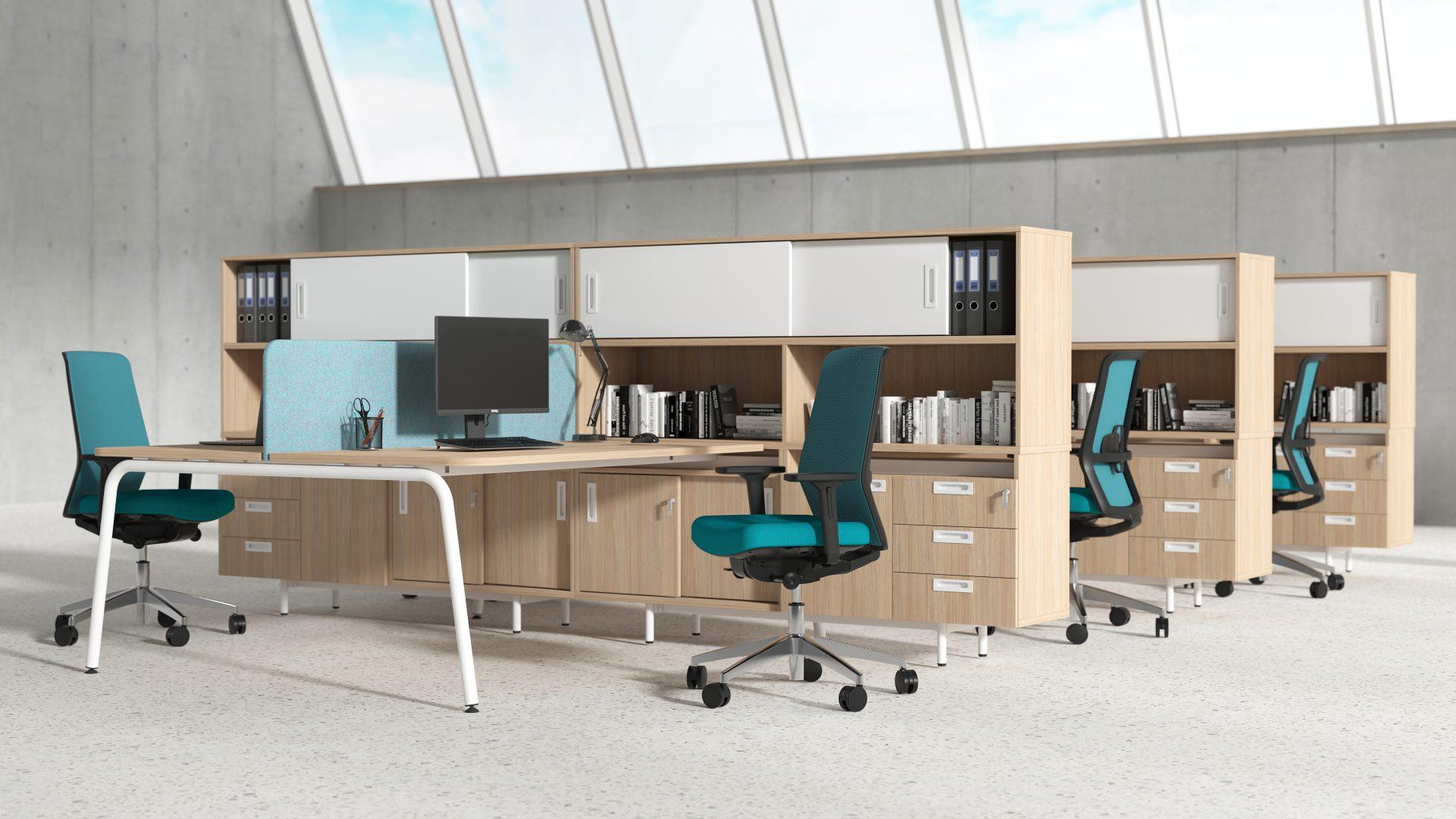
Another area where storage is becoming more relevant is in it’s use for space division. The pandemic and the shift towards greater homeworking has changed companies perception about the office, with many uncertain about how everything is going to unfold in the future with questions such as ‘do we need an office at all?.. should the office be smaller?.. how should we use the office?.. how should it be laid out?’ As a result, flexible space is even more pertinent and keeping the office as open-plan as possible (with minimal fixed/permanent floor to ceiling partition walls) seems to be the way things are going. But the resulting open-plan space still needs to be zoned, and workers still need privacy and quiet so that they can focus on the task at hand without distractions. This has given rise to the return of storage cabinets, some with acoustic sound reduction properties, to act as space dividers. Furthermore, multi-configurable workstations with fully integrated medium-height and tall storage has proven very effective at addressing such needs.

How much should new office carpet tiles cost?
15th September 2023

Investing in new carpet tiles can make a huge difference to the appearance of an office, often transforming it more than any other upgrade to furnishings or finishes. When we walk into a room, the floor is usually the first thing we notice so the design and condition of the carpet is the first impression we get of the general look and feel of the space. If the floor looks good, we might be less inclined to notice shortcomings in the other décor, such as walls or general furnishings. So if it’s purely a cosmetic makeover (rather than a functional rearrangement) you’re after, then the floor is often a good place to begin.
How much will it cost? The answer to this question is that we can only generalise because there are so many aspects to factor in and every office, situation and requirement is different, but in this article we hope to give you some typical price ranges, guidance and explanations.
There are 2 key factors to consider:-
- The cost of the carpet tiles
- The cost of fitting
Our assumptions are based on the supply and fitting of carpet tiles in and around London – other areas in the country could be less. All costs would be subject to the addition of VAT even if not specifically stated.
As a starting point, you should normally expect to pay a minimum of £20 + VAT per square metre (m²) for the supply and fitting of one of the quality yet lower priced entry level ‘heavy contract’ nylon carpet tiles. But don’t base your decision on this figure – read on – because I repeat, this is the minimum and in all likelihood you will end up paying more, possibly substantially so.
The above statement is based on the assumption that the carpet tile is one of the lower cost with heavy contract commercial rating and that the fitting is very straight forward with no complications. In general, this would mean a completely empty office (no furniture at all), a reasonable sized area, no existing carpet to remove and a sound subfloor that doesn’t need any repair or preparation work.
This nominal price is broken down as follows:-
Carpet Tile (per m²): £14
Fitting (per m²) : £6
What, then, are the factors that will result in an increase in price? Well, I’ve given a few clues to this in the last sentence of the previous paragraph, so let’s expand on that.
The Cost of Carpet Tiles
Carpet tiles come in a vast array of designs, colours, patterns and construction types from a host of manufacturers, both large and boutique, international and local. I’ve already mentioned the term ‘Heavy Contract’ and this means that the carpet tile meets the standard set for a product that is considered suitable for use in commercial environments where it may be subject to heavy use. Generally speaking, this means that we are focused on nylon (polyamide) rather than the usually lower cost polypropylene (although there are cases where the latter can be constructed into an extremely robust product), but this is a topic for another article.
The entry priced nylon carpet tile we have based our figures on above will be good quality and will perform well, but it may be just too plain, ordinary and flat looking for your liking, particularly if you’re trying to uplift the appearance of your office to another level. There are extremes, but in the main a carpet tile (excluding deliveries, fitting etc) is likely to cost anywhere between £14 m² and £40 m² – but you can pay more for some of the most elaborate designs.
So, for something that offers a more interesting and perhaps more luxurious and design orientated appearance then you should probably allow at least £20 m² plus the cost of installation.
Around £20 m² and upwards will generally get you varying degrees of better textures, patterns (often carpet tiles with multi-level textured patterns) and thicker/denser pile which will give a softer feel under foot and a more luxurious appearance.
Therefore, together with a very straight forward installation, a typical cost of supply and fitting of a somewhat more elaborate carpet tile range may be more in the region of £26 m².
The Cost of Fitting
This part gets somewhat more complicated. There are literally so many factors to consider that you would really need to speak to a supplier/fitter and they would absolutely have to visit your office to make a judgement on how long the process is likely to take, and what allowances need to be made for any fitting and repairing materials that might be required.
Here below is a list of approximate additional (minimum) costs that would need to be added to the base cost. This is not definitive and it is not intended to be an accurate guide. Instead, we hope it might give you an indication of what you might need to consider.
Removal and Disposal of Existing Carpet Tiles: Allow £2.50⁺ per m². Removing carpet tiles is time consuming and the cost of disposing of them is high. Usually they can be removed with relative ease but sometimes they can be stuck to the floor so hard that they simply won’t budge and we have to resort to exhausting manual work that could take many hours.
Repairs to sub floor (screeding): Allow £10⁺ per m². These days, it is more common to have a raised access floor in an office, but many are still concrete with a screeded finish surface. If the screed is cracked or crumbling (if the old carpet tile is stuck too firmly to the floor chunks of screed will often break off and become attached to the underside of the tile as it is pulled up) then it will need to be repaired with latex self-levelling screed which we mix and pour over the affected areas. This is not cheap stuff, and although there are rapid setting varieties, it is most likely that we’d need to wait until the following day before starting the carpet fitting – which in turn means a potential disruption to the work. With raised access floors, it is less likely that we’d need to carry out repairs, but bear in mind that we may still encounter problems with old carpet tiles that won’t come up easily and which leave some of the backing behind on the surface which will need to be manually scraped off.
Elaborate patterned designs with multiple colours of tile, inlays and/or herringbone style and boarders: Allow an additional £2-£10 per m² dependent on complexity. There are 2 factors here. Firstly, it can be extremely labour intensive (and much slower) laying an elaborate design. Secondly, there is likely to be more wastage with unusable off cuts so you may end up purchasing more carpet tiles than you would with a straight forward fitting. If we simply fit a different colour of carpet tile within different rooms, but they are all a uniform colour within each room, or if there is an occasional different coloured tile inserted randomly within an otherwise uniform format, then it is unlikely to increase the cost, but where we need to get into specific design layouts the cost is likely to increase.
Fitting around and under furniture: Allow typically an additional £3-£6 per m² dependent on complexity. If your office is occupied it is most likely that there will be all manner of desks, chairs, cupboards and other furniture that we would have to work around. Not only that, but we’d also have to remove the existing carpet tiles and dispose of them. Sometimes we can shift the furniture out of the way, other times we have to have people lifting whilst others slide carpet tiles underneath, and on other occasions we have no choice but to partially or completely dismantle and then re-assemble certain items of furniture in order that we can carry out the task. This slows the process down considerably – often it would take at least twice as long as it would if there was no furniture to move, and we would usually need additional hands to ensure the work can be completed. We’d also need to consider how much of the space we could realistically complete whilst your staff have vacated the office (perhaps weekends) so it’s possible that it may not be possible to complete the project in one session, but instead it might need to be phased over a number of separate visits.
I Hope you have found this useful. Yes, of course there are scenarios where you’ll get the whole project done for less, but these are the exceptions rather than the rule. A building landlord, for example, might want to make an office space reasonably presentable for re-letting and it is quite normal to fit the cheapest carpet tiles available, on the basis that the new tenant is very likely to change them out for something much nicer anyway. Or, as a condition of dilapidations, you might want to do the same yourselves and choose a very low cost carpet tile that you wouldn’t otherwise opt for if it was for your own use.
But broadly speaking, allow a reasonable budget and take good advice because with reasonable maintenance (regular vacuuming and occasional cleaning) a decent range will continue to look good for a number of years where as a low cost (but not necessarily that much lower in cost) will probably start looking very tired after only a few months.
Designing an Office for 2024 and Beyond
6th September 2023

Office interior layout and design has always been on the change, but never so much as recently following the massive shift towards home working. So what should the ideal office have in 2024 and beyond? How should it look and how should it be used?
The answer is that it varies from business to business and worker to worker who’s needs are determined by the specific role they play in the workplace. But there are some common themes that have established themselves relatively recently and which are probably here to stay – for the foreseeable future at least.
Over the years, offices have changed from predominantly cellular (lots of fixed and enclosed individual private offices and/or meeting rooms) to predominantly open plan. Open-plan has established itself mainly for 3 reasons:-
-
- Flexibility: The absence of cellular spaces created from fixed partition walls means that the office can be quickly and cheaply re-configured and re-designed simply by rearranging the furniture layout.
- Lower Cost: Fixed partition walls come at a considerable cost. In addition, a greater footprint is required to accommodate the same number people.
- Breaking down barriers between all levels of seniority: In the most extreme examples of open plan office design, the CEO sits in the same open space as everyone else.
-
Much of this has been fueled by the office furniture industry’s never ending need to innovate and create new products to sell, and part has been the view of the office occupying companies that they simply adapt to whatever is considered to be the norm – often going along with whatever push.
But open-plan simply isn’t ideal for all businesses or indeed all office workers. Some recent studies have suggested that we’ve taken it too far. They claim that far from encouraging collaboration, open plan arrangements have the opposite effect and employees often actively resist communication in such environments. Furthermore, many tasks require moderate to intense levels of concentration and for most of us, that means peace and quiet by distancing ourselves from the noise and other distractions of the office. Certain job roles benefit from sound and visual privacy 100% of the time, whereas others require a mix of collaboration and intense concentration. And of course, we shouldn’t overlook the fact that there are also those for whom this sort of open space is perfect – all the time.
So although open-plan is here to stay, simply because it offers flexibility and reduced costs in the main, it is the way that this space is zoned and the types of furniture and furnishings making up those zones that matter. The office of 2023 and beyond needs to offer a mixture of open plan areas, semi-quiet zones and enclosed private spaces. Within each space can be a host of different types of furniture dependent on company specific requirements.
There is one other very significant factor that has crept in during the past couple of years, and it slightly queers the line between what might be the perfect office design for achieving the greatest possible productivity levels, and what is going to be accepted by the people who work there. Full or part time home working has become the norm but it has become apparent that this is, for many businesses and workers alike, a far from ideal situation. Many companies are experiencing a drop in productivity (for many reasons which are perhaps a topic for another article) but are finding it difficult to reverse the trend back to a majority time spent working at the office. Equally, a vast number of employees are working from home far more than they want and would welcome the opportunity to get back in if only there was an office to go to, or one that is appropriately set up for them work from. We’ve all become used to working from the comfortable surroundings of our homes (albeit not necessarily ideal from an ergonomics perspective) and working at our laptops whilst sipping coffee in a local café and for many of us this is far more pleasant than being in the more traditional, somewhat formal and perhaps intimidating office with row upon row of hot desks, plain blue carpets and white walls.
So if we’re going to reverse this trend, we need to offer something similar yet much more appropriate than what we’ve become used to over the past couple of years. Most offices will need to have a mixture of designated quiet space for high concentration tasks, zoned space for individual groups and open space for informal meeting, collaboration, drop in and relaxation. Exactly what goes into these spaces and how they are designed, as mentioned earlier, can be extremely varied and tailored to the needs of the business. But that’s just part of it. No matter how practical and functional it is, absolutely key to the success is offering the workforce somewhere that looks good and offers as far removed from intimidating an environment as we can stretch it. Fundamentally, that means making the office a welcoming place by giving it a homely touch or making it more like the friendly café we’ve worked from part of the time for the past couple of years. There are many ways this can be achieved through a combination of decor (for example home-style designs of floor coverings in LVT or carpet tiles, exciting wall coverings and non functional furniture such as open book cases with ornaments) and soft seating from which people can work, communicate or relax. There needs to be a reasonable quantity of the latter, perhaps considerably more than is strictly necessary or that is going to be used at any one time, not least because it is going to be used for a combination of functions and people will want to spread themselves out. But referencing my comment earlier about the potential conflict between ‘what might be the perfect office design for achieving the greatest possible productivity levels, and what is going to be accepted by the people who work there’, the option of having a nice comfy lounge chair to work from in the office might be one of the hooks to lure people back, even if it isn’t the most practical or ergonomic way of working. In all probability, just in the knowledge that their office offers plenty of working options, people will ultimately migrate back to the most efficient way of working – such as from a desk – and use the other furniture on an as-and-when needed basis.