The High Cost of Vinyl Flooring Fitting Explained
2nd March 2023
Vinyl floor coverings are becoming increasingly popular, not only for offices and other types of commercial buildings (including shops, cafés, restaurants, hospitals etc) but also in homes. They come in large continuous sheets as well as tiles and planks (the latter generally referred to as Luxury Vinyl Tiles or LVT for short). Today’s higher quality vinyl is available in a huge array of designs, colours and patterns including very realistic ceramic tile or stone appearances to wood effect planks and much more.
The cost of the product itself is often fairly insignificant compared to that of having it fitted in your home or office. It begs the question – why?
In our business, we generally fit out offices and most of our customers choose to have their office floors covered in either carpet tiles or vinyl – and sometimes a combination of the two. Notwithstanding the fact that in any case heavy contract (hard wearing for commercial environments) vinyl products are on average priced higher than carpet tiles, the differential in fitting costs is normally vast. The resultant fact is that it’s normally considerably cheaper to have your office fitted with carpet tiles than with a sheet vinyl or LVT.
The reason for this is that carpet tiles are far more forgiving and tolerant to substrate condition (substate meaning the surface onto which they are to be laid), require far less skill to fit and are many times quicker (by a significant factor) to fit than vinyl.
A carpet tile will often sit nicely on a slightly uneven floor, and it will most certainly sit directly onto a raised access grid floor typical of most modern offices. Environmental conditions such as relative humidity are also less of an issue with carpet tiles.
At this point in my article, it is important that I point out that I’m talking about vinyl, both sheet and tile, which has to be stuck down firmly to the floor. There are also other types such as loose lay and click-fit boards which do not need adhesives (or not much anyway) but these are a topic for a different article. Needless to say these too have limitations but not necessarily the same limitations and considerations.
So, to set the scene, let’s take a typical scenario for today in 2023. Its reasonable to assume that given the right conditions – i.e. a relatively large open plan office area which is completely empty and has a floor which is in adequate condition that does not require any filling or preparation – that you could pay as little as £20 + VAT per square metre for the supply, delivery and fitting of an entry level priced albeit good quality heavy contract nylon carpet tile. By comparison, its reasonable to assume that for an equivalent entry level priced LVT (luxury vinyl tile) you are almost certainly going to be required to spend upwards of £70 per m2. And I am speaking only of the lowest cost of the reasonable quality products in each case.
So why the difference and what makes it more costly to fit vinyl flooring?
Step 1: Moisture Testing: If vinyl is laid onto a substrate (surface) that has more than a certain level of moisture content then it will almost certainly fail. It could fail within a few days or it could take a year or more, but at some point it will almost invariably do so. And by failure, I mean that it will start to become detached (unstuck) from the surface its adhered to and this might be at the edges or corners, or it could reveal itself as bubbles or air pockets under the surface. Once this happens, there is no point attempting to re-glue it because the same will happen again. Furthermore, in addition to the peeling the material could also shrink or expand meaning that it will never go back properly anyway. With LVT, expansion will mean that the individual tiles will push against one another causing them to “blow” resulting in them all curling up at the edges and in such circumstances we have a problem that can not be ignored.
To ensure that none of this happens, the fitter needs to check that the relative humidity of the substrate floor is within acceptable levels. A floor might look dry and feel dry, and it is easy to assume that it is dry given that, for example, it is on the 4th floor of a modern building which is only a few years old (or perhaps brand new)! But the floor is likely to be screeded with sand & cement, or calcium sulphate, or one of many other types of substrate levelling coverings and all of these contain a high level of water when first poured. Some never dry out and the moisture is sealed in whereas others can take weeks or months to fully cure and lose their moisture content. Prior to 1965 there was no requirement to have a damp-proof membrane (DPM) under the concrete slab, so any ground floor of a house or commercial building would have a concrete slab that is continuously sucking up moisture from the ground and it will invariably be too damp (even though it may feel dry) to lay a vinyl covering without any further preparation.
So, before any work can begin, we need to carry out moisture tests on all types of hard floor surfaces, be they old or new, and this means taking readings with digital devices and then drilling holes and inserting probes and/or leaving hydrometers stuck to the floor for a few days in order to get the necessary readings. Once we have the readings, we know what we will need to do. This takes time, involves relatively expensive equipment and the cost of this needs to be factored into the eventual fitting.
If it turns out that the relative humidity is within acceptable levels, we can move straight to the next stage, but if not, we will have to apply a liquid damp proof membrane to the surface before continuing. But its not a simple case of painting on any old DPM. It has to be the correct type for the level of dampness, and the type of surface it is going onto. Certain DPMs will not stick to certain types of surface, and/or will not give sufficient protection. Again, cost-wise not only is there the time involved applying it and waiting for it to dry before moving onto the next stage, but the price of the DPM which can amount to a few hundred £ for just a few square metres. Nonetheless, it is an absolutely essential step.
Step 2: Primers and Levelling Compounds: The floor surface might look nice and smooth, but it has to be absolutely smooth and flat. The slighted dimple in the substrate or bit of grit left on the floor will show through the vinyl floor – far more than many can imagine. Most surfaces, even if they have been screeded to a sufficient level that would easily pass for a carpet or carpet tile installation, would not be even enough for vinyl fitting. We have to, therefore, apply a levelling compound (and incidentally a primer which we would have also had to do in step 1 above) which is a floated onto the surface, usually to a thickness of between 3mm and 6mm or thicker where there are deeper undulations/troughs that have to be filled. Once it has cured, which can be a matter of hours or days dependent on the compound used, it is ready to be lightly sanded down to take off any small bumps or lumps, filled wherever necessary, in readiness for the vinyl to be fitted. Again, there are numerous types of levelling compound which vary in cost, each having a specific use be it for a particular type of substrate (some compounds are not compatible with certain substrates) and with varying speeds of curing/drying. Each of these compounds is relatively costly (like the DPMs can be £ hundreds for just a few square metres) and again we also have to factor in the cost of labour.
The above description assumes the substrate is a hard surface. But In the event that the floor surface that the vinyl is being laid on is not a concrete or screed but wood, chipboard or even a raised access floor in an office, then it can not be laid directly onto these either. What would normally happen is that the fitters would have to lay flooring grade 5.5mm plywood (minimum thickness) on top of the existing surface, secure it with hundreds (or thousands dependent on area) of screws or nails, and then fill the gaps between each board and screw/nail holes with a filler and sand down once dry. The flooring grade plywood is amongst the most expensive type of plywood available, and the fitting of it is very labour intensive indeed.
Step 3: Laying the vinyl floor: As mentioned earlier, just the slightest bit of grit trapped under the new vinyl can be very noticeable (remember that the vinyl sheets are typically only a couple of mm thick! So sweeping and vacuuming is all important. Prior to all of this, the vinyl, be it a roll or tiles, has to have been sitting inside the building/room in which it is to be installed for perhaps as much as a couple of days so that it can be brought up to room temperature. Everything has to be at the same temperature so this means that it may require the boxes to have been unpacked and the individual tiles laid out to warm up, particularly if they have been sitting in a cold warehouse, storage facility or van prior to being delivered to site. Furthermore, there is an ambient temperature range within which the vinyl can be correctly laid. Too hot or too cold and it will lead to disaster and if the room can not be brought up or down to within this range the fitting can not take place. Why? – because the vinyl expands and contracts with temperature, so if it is fitted at one temperature and the room then heats up or cools down significantly, the tiles or sheets will shrink or expand accordingly after having been stuck down. This will lead to blowing where the joins between each tile push against one another and raise up from the floor, or contraction leaving gaps.
Where sheet vinyl is being fitted, this needs to be un-rolled, back-rolled (rolled back up in the opposite direction to which it left the factory) and left to sit on the floor for some time before it is ready to be glued down.
Having ensured the vinyl has reached the same temperature as the room, and that the room temperature is within the acceptable limits, laying can finally commence. Note that the process leading to this point has taken a number of days and potentially a considerable amount of materials.
Sheet vinyl and LVT (tiles or planks) are the same material but laid slightly differently and there are different/additional processes. In both cases a suitable adhesive needs to be applied to the floor, and the type and cost of adhesive depends on how fast or slow we need to work, and the type of surface it is to adhere to. Some stay tacky for a reasonably long time and allow us to spread it over a large area first before we begin laying the vinyl, and others go off very quickly which means that we have to apply the adhesive and lay the vinyl to smaller areas as we go along. Either way, laying LVT is a relatively slow process which slows down considerably more if creating patterns, boarders or applying in herringbone or parquet fashion. Obviously, the smaller the tiles (parquet size for example) the more time consuming it is, to the point that it can take many, many times longer than large planks laid in a regular pattern or indeed sheet vinyl.
Sheet vinyl is generally much quicker to fit than LVT, but there are circumstances where it can become very involved and with much skill required by an very experienced fitter. Firstly, the rolls come in different sizes, but typically they would be 2m wide by many m long. Therefore, to cover a large area it will be necessary to lay a number of sheets and where these join, they need to be welded together. This requires specialist tools and an experienced fitter. Secondly, in many environments (hospitals, carehomes, wet areas, WCs etc) where hygiene is of great importance, it is common practice to wrap the vinyl up the walls by using a technique we call ‘cap and cove’. This is tremendously time consuming and a job for only the most skilled and experienced flooring fitters.
Conclusion
So, to summarise, over and above the cost of the product itself, vinyl floor fitting involves a huge investment in time and materials. In general, it is far more complex than fitting carpets or carpet tiles and accordingly takes a far greater amount of time. Furthermore, 99 times out of 100, in order to achieve a satisfactory result it will be necessary to take one or many additional steps over that of typical carpet or carpet tile fitting such as checking for moisture, applying a damp proof membrane, priming, creating a flat smooth surface with plywood or levelling compound, filling, sanding and cleaning. The additional materials to achieve this will run into £10s or possibly even £100’s per metre, and the labour costs are also very significant because it is, simply put, a skilled and slow process.
Next time you need a nice new LVT floor fitted to your house or office, please don’t be surprised by the cost. If during the consultation/quoting stage the contractor offers what seems to be a very attractive price but does not inspect the floor or carry out moisture tests – or otherwise give you a very good reason for not doing so – then alarm bells should start ringing. Likewise, if they say they’re going to lay directly to a chipboard surface or floorboards, or a direct to earth concrete slab then seek further advice. Remember, once its in and it fails (or when lines or dimples start appearing where all the joins are in the floorboards or chipboard surface or screed below) it is unrealistic it can be taken up and re-laid or stuck down again. Instead it will involve taking everything up, throwing it away and starting again and doing it properly the next time – by which time you might have had built in furniture, kitchen cabinets and the likes fitted on top so it could become even more complicated.
Farrow and Ball Paint – Any Good?
31st January 2022
 Farrow and Ball is a very popular and successful paint brand and, it seems, loved by interior designers and home owners alike. But speak to professional decorators and there will probably be as many (or more) that will give it the thumbs down as there are that will be complimentary about it. So why is that?
Firstly, I should point out that I’m not a professional decorator but rather a very competent amateur who has done a great deal of interior work, including assisting my contractors on commercial projects on a number of occasions (I run an office fit-out business) so I’m sure that for every negative thing I might say in this article there will be others (professionals and/or very experienced amateurs) who will disagree and point to the fact that they’ve never had the same issues or that I didn’t follow the manufacturers guidance properly. But then I consider this to be very relevant to this article simply because Farrow and Ball is marketed at, purchased by and probably applied by far more homeowner do-it-yourselfers than professionals, so the suitability for use and application by the inexperienced must be an important consideration.
Secondly, I need to say that any comparisons I make will be with brands that I’ve used extensively in the past such as but not exclusively Dulux and Johnstone’s (in both cases the Trade versions) but it is worth noting that there are a number of other brands that compete far more closely with Farrow and Ball and some with apparently a very good reputation – the likes of Little Greene and the Paint & Paper Library come to mind – but as I haven’t used these I’m unable to give an opinion.
So, onto my experience! We bought a large and slightly dilapidated house and I set about stripping it back to the bare shell and re-building it – partly myself and partly with the help of professionals. When it came to decorating, our interior designer specified Farrow and Ball – everywhere, walls, doors and even the kitchen cabinets.
There were three things I already knew about Farrow and Ball (from hereon I will refer to Farrow and Ball as F&B). Firstly it’s rather expensive and secondly, although the Estate Emulsion has a fabulous appearance, it is very delicate and apparently (I had heard) quite difficult to apply. On both accounts I wasn’t sure it was the right choice for us. The interior designer specified F&B for its unique colour range and its texture and I wanted to see if we could find a lower cost, more durable alternative that would satisfy both her and my wife who was also quite keen on the idea of F&B.
My understanding (wrongly as it turned out) was that Dulux and Johnstone’s can colour match, so I purchased a sample pot of each of the 4 colours we were going to use from each of the 3 brands. Although the Dulux and Johnstone’s were very similar, they weren’t the same on a side by side comparison and the designer and my wife both preferred the F&B colour in each case, so the decision was made!
F&B say their colours are unique and that’s one of the reasons for buying their paint. Judging by my very limited experiment, at least for the 4 colours we compared, it appears that they are correct on this matter of uniqueness and I have to conclude that if you want specifically an F&B colour and a near match won’t do, then you have no choice but to buy F&B – and it will cost you considerably more than most other paints.
Estate emulsion versus Modern Emulsion
The next point I made was about durability and I’m referring mainly to emulsions for walls rather than wood paints (more about those later). The thing about F&B is that they are known, and liked by many, not only for the unique colour range but also the texture. Their main range is called Estate and has a very traditional chalky matt appearance. I agree, it looks absolutely fabulous but it comes at a cost – it’s very delicate and prone to damage and marking and once it is marked (whether by finger prints or dirt/spillage) there seems to be no way of bringing it back to its original uniform appearance – it can’t be wiped down as that makes it look even worse – so the only real solution is to decorate the entire wall (or section) again. The darker the colour, the more the marks show up (more about this later).
I knew that this wasn’t going to be suitable for many areas in our house, in particular the staircase, hall and landing, so for these areas, and many others, we went for Farrow and Balls ‘Modern‘ range which I knew about simply because on a couple of occasions my decorators had used it for office projects. Modern is a much more durable paint than Estate and it is also wipe-able so you can use it in bathrooms, but although the range of colours are the same, it most definitely doesn’t have the flat matt chalky appearance of Estate, but instead a bit of a sheen. In fact, as we discovered, the darker the colour, the more noticeable the level of sheen seems to become. To conclude just on this point, relatively durable it has proven to be (after 12 months since decorating), but I’m disappointed in the appearance of our entire hall, staircase and 1st floor landing which was all decorated in Modern DeNimes colour and just doesn’t have that wow-appearance we wanted. Light from windows and lights catches it and it just doesn’t do it for me! I feel we’d have been better off using a standard Dulux vinyl matt paint, or better still their Diamond range which, although also has a bit of a sheen to it but in my opinion less so, is also considerably cheaper. By contrast, most other rooms were painted in Modern School House White (a very pleasant slightly off-white colour) 
 and in general it looks pretty good and most certainly seems to have a lot less sheen. Interestingly, we did paint certain areas in Estate (rather than Modern) School House White and it’s actually quite hard to spot the difference under normal lighting conditions, even where we have Estate and Modern adjacent to one another. That’s appearance, mind you, and plenty of marks, scuffs and dents have appeared in the Estate that are not apparent with the Modern.
Our bathrooms are all decorated in Modern School House white, and again, it has stood up very well and is most definitely wipeable and resistant to condensation and splashes.
Ease of Application & Coverage: Both the Estate and Modern emulsions were easy to apply and went on smoothly and evenly, although I did have a few issues which are mentioned later. I didn’t experience ‘picture framing’, a complaint that I’ve heard many times about Estate Emulsion and which apparently makes it more difficult to use because you have to be very quick with your work. Picture framing is the effect caused by the paint you ‘cut-in’ around the top and sides of walls drying so quickly that its already dry before you are able to paint the central/main part and blend in the two. The result is that you end up with a visible ‘frame’ around the edges of the wall, but as said earlier, I didn’t suffer from this, even with the darker colours of Estate (and we used one particularly bold & dark colour) so I had absolutely no issues whatsoever with ease of application or appearance.
These were the good points, but with these come a very major negative. The main and serious gripe I have is that litre-for-litre, not only is this paint far more expensive than most, but it also gave me less coverage than I was expecting so I ended up buying quite a lot more than I’d anticipated. To help explain this, very broadly speaking, you get 2 different types of paint, one type aimed at the occasional DIYer (retail/consumer paint) and the other for professionals (trade paint). Ignoring the really cheap own-brand budget paints from DIY stores (the sort you pick up for £10 or less for a 10 litre tub) and focussing on the quality brands, the Retail paint is often thick and gloopy (a bit like blancmange) and is such so that it’s easy for the the inexperienced decorator to load it up onto a roller and apply it without too much dripping off. The Trade paints tend to be thinner (although they generally still give more coverage than the consumer paints), and can be applied direct from the tin or mixed with water to thin them down and make them go further and allow a smoother, more even application (a lot of professionals will add water to their trade paints for this reason). What I found with the Farrow and Ball emulsion is that it is extremely runny/watery compared to others and from its appearance and consistency when you open the tin you’d be forgiven for mistaking it for an eggshell or gloss wood paint. In fact, and more about this later, the F&B emulsion looks exactly the same as you’re pouring it out of the tin as their eggshell, and given the fact that all their tins are identical apart from the small sticker telling you what is inside, it is very easy to make a mistake and start putting eggshell onto a wall instead of the intended emulsion – as I did on more than one occasion! So why does this matter? Well its simply that in general, I used a lot more paint than I would have done had I have used, for example, Dulux trade. You would normally expect two top coats to be sufficient, and at times I was achieving this, but only by applying the paint more thickly than I’d want, and sometimes I had to apply 3 coats – either way, using more paint.
Finally, on the issue of application and cost, there was one other consideration to factor in. A few weeks after decorating, I found that in certain places small areas of the Estate Emulsion peeling off the wall. Furthermore, wherever I have subsequently used masking tape on both the Estate and Modern, a fair amount of paint came off on the back of the tape when it was removed. I was using the expensive low tack tape for delicate surfaces from 2 major brands – Frogtape (yellow) and Tesa (pink) – and I was using them in the correct way and only leaving them on for a matter of minutes or hours rather than days. Although I have experienced this before with other paints, it has been rare and certainly not as extensive as I found with the F&B paint. As far as I’m concerned, we did everything correctly with regard to the preparation of the walls. They were all newly skim plastered walls and had been left to cure in dry ventilated conditions at least 3 months before decorating began. I prepped the walls in the way you would normally do so with newly plastered walls, and that is by doing one or more mist coats of diluted non-vinyl emulsion and for this I used mainly Brewers Contract Matt and to a lesser extend Leyland Trade Contract Matt. In general, I did a first coat of highly diluted paint (very watery) followed by a less diluted but still quite runny coat. In each case, at least 24 hours was allowed between these coats. For reference, it is absolutely imperative to apply a watery ‘mist coat’ to new plaster and that’s because you need to create a surface that the top coats/finish coats can stick to. Without going through this process, the finish coats will just sit on top of the plaster and are likely to bubble or peel off over time. You should never use vinyl paint for the mist coat, I’m not entirely sure of the science behind this but I believe the vinyl prevents the paint from penetrating the plaster efficiently and therefore using it is no better than not doing a mist coat at all! So, most Dulux paints wouldn’t be suitable because they’re primarily vinyl based, although you could, hypothetically use watered down F&B paint but it would be a very expensive way of achieving the result as a contract matt will be a fraction of the price.
So, maybe I did something wrong, or maybe there was a bit of dust on the walls I didn’t clean off properly before decorating, and maybe this would have happened anyway even with a different brand of paint, but I don’t think so. More likely, if I were to complain to F&B, I would probably be told that I didn’t follow their procedures, which is that you should use their very expensive primer/undercoat before decorating with any of their paints – yes, they have a dedicated  undercoat primer for walls and ceilings, and another one for wood etc. I have read and heard on a number of occasions that F&B is intolerant to other brands (and methods) of primers and undercoats and that if you don’t use their own brand you risk unsatisfactory results. But to have done so, the cost of the project would have rocketed even more and I decided therefore to take the risk of not doing so.
Farrow and Ball Eggshell
I got through a great amount of eggshell which was used for all doors, architraves, skirting boards, cupboards and kitchen cabinets. Much of this was MDF, some of which was pre-primed but most of which I had to prime myself.
 Initially, the kitchen cabinet frontages were my main concern – there were a lot of them and we had bought ‘paintable’ cabinets from Howdens. Howdens’ blurb said that these were supplied already primed and ready for painting (top coats). They recommended using oil based paint rather than water based/acrylic to give a harder wearing finish and that application should be by brush. When buying them I hadn’t looked too closely and expected these to be a wood finish (either straight MDF or a thin wood veneer, but in fact they were an MDF core wrapped in a sort of plastic/melamine like material. After my initial panic that this was going to be disastrous, I bought a tin of F&B Estate Eggshell in our preferred colour of Stiffkey Blue (which of course is a water based paint as they don’t do oil based), and set about experimenting on a couple small doors with a brush and a roller to see which would give the best result. My worst fear – both were a disaster. The paint took days to completely dry to touch (to the point that if you apply pressure you won’t leave finger prints within the paintwork) and never (not at least within a reasonable timescale) to be able to lightly sand between coats, so the appearance was terrible. I initially thought the problem was the surface I was painting onto, so I started again, this time priming the surface with some F&B wood primer I had left over from a commercial office job, but still got the same results. Finally, I tried it on some off-cuts of veneered plywood, using both F&B primer and Zinsser Bulls-Eye 123 (my favourite all rounder) as the base but the Eggshell still it remained tacky for days on end. Whilst looking over F&Bs price list it suddenly occurred to me I’d been using their Estate Eggshell and that they also do a Modern version. I had no other option but to try, so I purchased a tin of this and what a difference! Appearance wise it looks the same. The colour is identical, but it dries quickly and went straight onto the Howdens cabinets without a problem and without a primer. I later learned that this used to be F&B’s hard wearing floor paint which they later re-branded ‘Modern’.
Water based paints are the future, no question, and many manufacturers, including F&B, have stopped making oil based paints completely. But no matter what the manufacturers say, and I think many professionals will agree with me on this, it is still a lot easier to get a really good finish with an oil based paint. It can still be done, but a different technique required and its more difficult with water based which I learned the hard way. So if anyone reading this needs a little advice, the trick is to apply it (water based/acrylic paint) a bit more thickly and only do a few brush strokes (i.e. don’t over-brush and keep going over and over it like you would with an oil based paint) because the acrylic paint will start to dry within seconds whilst you are brushing (or rolling) it on and it the moment it starts to harden you need to stop brushing otherwise the brush stroke marks will become very visible. Furthermore, it is handy to have a water spray dispenser to hand and just squirt a very thin mist of water onto the surface you are painting which will help the paint to flow/run-out a bit more easily. This aside, going back to the subject of my kitchen cabinets, I still couldn’t get the really smooth finish I wanted, and this was nothing to do with the paint but simply because the doors were tricky to paint, so in the end I decided to spray them instead. Using a HPLV paint sprayer, I sprayed all of the kitchen cabinets and associated pieces of cornice and bespoke MDF infill panels we cut to size ourselves, and the results were really fantastic. I continued the paint-spraying beyond the kitchen to include bespoke bookcases & TV cabinets and bespoke hallway coat cupboards, all of which we had made from MDF. I also sprayed most of the doors which we had made from wood veneered plywood fire-door blanks and a couple of existing bedroom wardrobes, all of which we primed with Zinsser Bulls Eye 123. The results in all cases were excellent.
The only woodwork I hand painted with a roller and/or and brush, we the occasional door, the skirting boards and the architraves and I’m pleased to report that the Modern Eggshell came up trumps here too. More than a year on, it has proven to be very hard wearing. Even the kitchen cabinets have stood up far, far better than I had expected. I really thought that by now I would be having to respray some bits and touch up others, but that’s not been the case.
And one last thing. We painted all the ceilings with Dulux Vinyl Matt emulsion to save money (because white is white) and they look great as expected, but we also painted all the window sills in Dulux Satinwood (again to save money because these were to be the only pure white surfaces we were going to decorate and I felt it would not make any difference – appearance wise – whether we used Dulux or F&B). As it turned out, the Dulux satinwood was much more difficult to apply and get a smooth finish than the F&B. It was thicker and stickier on application and needed to be watered down (either by mixing water into the paint or by spraying a mist onto the surface whilst painting – or both) in order to get it flowing better. Get the right mix of water and it was more like the F&B so you could argue again that F&B coverage isn’t so good because their paint is already more runny out of the tin. For a professional, working on the consistency of paint by adding water to get it just right is probably not a big deal, but for the amateur, I have to say that F&B have probably got theirs pretty much right – even if it is considerably more expensive!
Conclusion/Summary
Setting aside the issue of cost, all in all I have far more positive things to say about Farrow and Ball paint than negative.
- Cost: Expect to pay far more for F&B than most other paints. A litre of this paint not only costs considerably more than a litre of most other (quality) paints, but in my experience the coverage isn’t quite as good so I ended up using a greater volume than anticipated.
- Eggshell: Avoid Estate Eggshell and use Modern Eggshell instead. There’s only a little difference in cost and the Modern is far superior – its harder wearing and it’s much, much easier to work with and get a good finish. Side-by-side the colour looks identical. I don’t understand why they bother to continue to offer the Estate version. As far as water based paints go, Modern Eggshell is easy to apply and gives a nice finish whether being applied by brush, roller or spray gun. It has proven to be very hard wearing in my house – apparently this used to be F&B’s hard wearing floor paint which they later re-branded as a general wood paint.
- Emulsion: Both Estate and Modern are easy to apply and go onto walls nice and smoothly. They also dry quickly. The smell of Modern in he tin is slightly odd but not necessarily unpleasant and is fine once on the walls. Modern is great for bathrooms and high traffic areas, but has quite a sheen to it which is far more noticeable with the darker colours than the lighter ones, so it won’t be everyone’s taste and certainly doesn’t give that classic appearance that Farrow and Ball is known for (the chalky-matt finish). Furthermore, the sheen shows up discrepancies within the paint work and any unevenness of the walls that the matt appearance of Estate is likely to hide better. Estate, on the other hand, looks fab but is rather delicate to the touch so for any higher traffic area that’s likely to get brushed past, scuffed or knocked it will probably look absolutely dreadful in a fairly short space of time and be in need of a re-paint. Shame F&B don’t have a paint that is somewhere in between the two.
- Colours: If its specifically the F&B colours that attract you and you want an exact colour, then buy F&B and forget colour matches from lower cost brands – in my experience they don’t look the same.
- Texture & Colour combination: Although not mentioned in the main body of my article, bear in mind that the the F&B sample pots are only available in Estate Emulsion. You can not buy a small cheap sample pot for Modern Emulsion, nor Estate or Modern Eggshell or Gloss. So don’t make the mistake of judging by the appearance and colour from an Estate Emulsion sample pot when you’re intending to use Modern Emulsion or an Eggshell/Gloss. Not only is the texture of Estate different, it will also give a slightly different colour appearance due to the less reflective matt finish. Also, the colours will appear different (sometimes quite considerably so) dependent on the lighting conditions in the room. And, if you are intending to use Modern Emulsion, then buy the smallest pot you can and test it out so to be sure its what you’re after (I think this is a 750ml tin which will cost a fair few quid but its better that way than spending £100s or £1000s on something you find you don’t like).
__________________________________________________________________________________________
Matt Black Desks – How Practical are they?
25th March 2021
My business, Octopus Interiors, sells desks with black worktops. We do lots of other colours and finishes too but the black desks are by far the highest cost and, in my opinion at least, have the biggest wow factor. I’ve seen them in the showroom and I’ve sold them to a few customers and everyone loves them, but I’ve never actually used them myself for a prolonged period of time.
So, the question is, how good are they and are there any drawbacks?
When I came to kitting out my home office with new desks and chairs I wanted to make it look as nice as possible so I opted for the black-topped desks with wooden legs. Here below is a photo of the desks we installed.
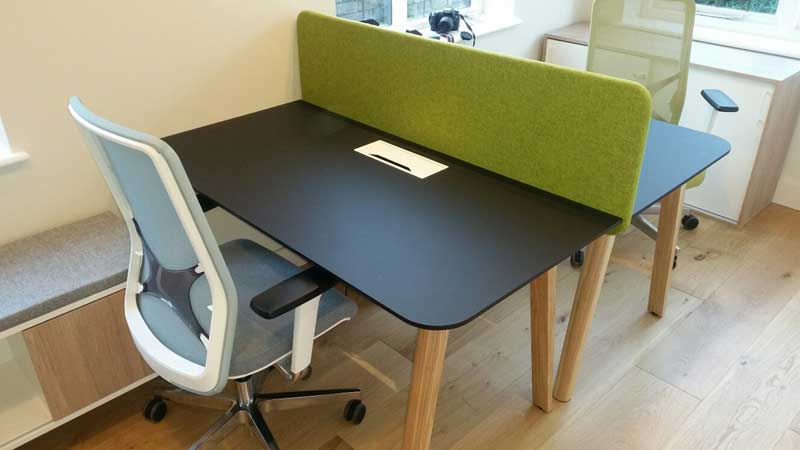
The first thing I have to point out is that the photograph doesn’t do them justice. The surface looks blotchy and shiny but this is entirely down to the camera flash and not such good photography on my part with my Samsung Galaxy phone. They are actually a beautifully smooth matt finish with only very minimal normal light reflection.
Most desks are made from MFC (Melamine Faced Chipboard) and although fairly robust it is susceptible to scratching and denting. Kitchen worktops, by contrast, tend to be HPL (High Pressure Laminate) and this is far more hardwearing – more impact resistant, scratch resistant and heat resistant. Like MFC, HPL is often bonded to chipboard, but sometimes to MDF which is heavier, denser and stronger than chipboard.
My black desk tops are the best of both, being made from HPL with an MDF core and this is why the cost is so much greater than our standard range of MFC finishes, but not the only reason. The black HPL top costs around twice as much as the white equivalent, which in turn costs about twice as much as a regular MFC top. When I was making up my mind what I wanted, I started delving into the sample box and came across a black MFC finish. The manufacturer doesn’t offer this as an option for desk tops as it is only included in the range purely for their cupboards. I always wondered why until I noticed that the sample I was holding was absolutely covered with finger prints, something I was aware of and that I’ve noticed previously on many other darker coloured desk finishes such as dark greys, walnuts and so on, but I’d never realised quite how badly it all showed up.
The black laminate top of my desks are, by contrast, a finger print resistant and anti-reflection finish and I can assure you that they really do live up to that claim – although as a caveat that statement I should say that greasy finger prints will show!
So, having spent the past few weeks at my new desk, I’m very happy and very impressed. They’ve withstood knocks and scratching and they look absolutely fantastic. But now to the downsides, albeit very minor ones. Fingerprint resistance aside, they do show up more than conventional white or most wood-effect tops dust, coffee cup marks and grease marks. To my delight, because I get to spend even more time with them, both my son and daughter far prefer doing their homework in my new office rather than their own bedrooms, but with it comes the issue of mugs of hot chocolate, sticky cakes and greasy fingers, all of which lead to a bit of a mess on the worktops, but nothing that can’t be easily wiped off with a damp cloth so a small price to pay for the pleasure of spending more time with the kids!
And finally, the cats. Finger print resistant doesn’t translate into ‘paw resistant’ – I didn’t see that one coming! On the first day, no less, the cats came in from outside with muddy paws and left a trail of prints all over the desks.


To conclude, if you want black desks then they absolutely need to be a fingerprint resistant finish – as these ones are. Anything less would quickly look absolutely dreadful and would be a disastrous purchase for your office. Now that I’ve put them to the test in my own home, would I recommend these fingerprint matt black HPL desks to customers in the future? – Absolutely yes! They will cost considerably more than our regular desks, but surprisingly not much more (if at all) than other suppliers’ regular desks and they just look so cool!
_______________________________________________________________________________________________________